 |
||
|
|
|
|
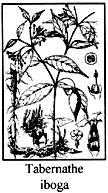 |
Introduction Of the various drugs that have been proposed as being useful in the treatment of chemical dependence, ibogaine is almost certainly the one that offers the greatest real potential. Ibogaine is a slightly psychoactive indole alkaloid derived from the Tabemathe iboga plant native to Central Africa. Members of the Bwiti religion, an indigenous group, use the plant for a variety of social and religious purposes. Notably as the central component of a "rite de passage" initiation ritual design to confer the status of adulthood upon the initiate. And, in much lower doses, as a stimulant for increasing concentration when hunting or fishing. In the West, ibogaine is usually administered in the form of the hydrochloride - a fine off-white powder either synthesised or chemically extracted from the root bark in a laboratory When administered to persons seeking to beat addiction to heroin, methadone, cocaine or alcohol, a single dose of ibogaine typically achieves the following: Firstly, complete removal or severe attenuation of the symptoms of withdrawal, allowing the addict to detoxify painlessly, (occurs with approx 90% of subjects). Secondly, removal of the desire to use drugs for a period of between one week and three months, (occurs with approx 70% of subjects). And, thirdly, the experiencing of insights that helps the subject understand and thus interrupt their drug-using behaviour, (occurs with approx 40% of subjects). Ibogaine is not itself addictive. And follow-up dosing may be undertaken to help preserve a drug-free state. The discovery of ibogaine's dependence-interrupting ability is usually credited to Howard S. Lotsof - a New York based former drug user who first consumed ibogaine in 1962. Lotsof, then a heroin user, took ibogaine assuming it to be a new recreational drug. But, 30 hours later, suddenly realised he wasn't experiencing heroin withdrawal, and had no desire to seek drugs. Subsequent casual experimentation revealed this effect was common to other heroin users. Some 20 years later, Lotsof returned to his discovery and set about trying to market ibogaine as a treatment for drug addiction. By this time, unfortunately, ibogaine had been made a Schedule 1 restricted substance by the US Government. (Many drugs credited with psychedelic effects were banned during the sixties. Note that ibogaine is unrestricted in the UK and most of Europe). Consequently, Lotsof chose to carry out ibogaine treatments in Holland. Jan Bastiaans, a Dutch psychotherapist, partnered him. And they flew in some 30 American heroin addicts who had volunteered for treatment. Lotsof reported that two-thirds of the volunteers remained drug-free for periods ranging from 4 months to 4 years from a single administration of ibogaine. He published the reports of his research, creating some interest in scientific circles. Studies were commissioned by major pharmaceutical companies, but their interest in the project waned with time. Undeterred, Lotsof formed a corporation, NDA International, and endeavoured to bring ibogaine to the market himself. However, the US medical authorities seemed ill at ease with the arrival of an outsider within their midst. Lotsof claims they blocked his attempts to make ibogaine available by constantly stalling on the issue of carrying out necessary trials. NIDA, (the US National Institute for Drug Abuse), say that this is not the case. And that the main reason they're not interested in ibogaine is because it's only shown to keep people off drugs for a period of months - not forever. Lotsof comments that any drug that could put say, cancer or AIDS, into complete remission for a period of months would be being developed as a matter of national urgency. But, regardless of who's position is correct, ibogaine development has now come to a complete halt with the collapse of NDA International. This happened, Lotsof alleges, because of excessive delays by University of Miami staff, employed by NDA, to complete an FDA approved study. And ibogaine development is now in a state of "impasse" until new backers can be found. If you have an addiction problem and want to change, then ibogaine can help Links to more ibogaine resources available at www.ibogaine.co.uk/links.htm . |
|